
Sumitomo Electric offers a wide variety of cables and devices to meet the ever-changing needs of electronics designers in different industries. To learn more about a particular product, please use the links below.
- Flexible printed circuits
- Flexible flat cables
- Micro flex coaxial cables
- Thunderbolt™ 5 cables
- RGB laser modules
Flexible printed circuits (FPC)
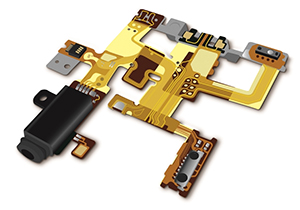
Flexible printed circuits are a patterned array of conductors supported by thin and flexible dielectric film. One of the most versatile electronic interconnect products, FPC is widely used in advanced electronics such as automobiles, robotics, medical equipment, and consumer electronics. As device manufacturers add more and more functionality to their products, we keep pace with requirements by providing many types of FPC with advanced features. Examples include high flexibility, ultra-softness (low spring-back), high shape retainability, ability for high-speed transmission, high heat-resistance, and fine-pitch circuitry. Through continuous R&D we are able to address new needs for miniaturization, lighter weight, and higher functionality.
Sumitomo Electric Printed Circuits, Inc. (SECT) specializes in the development and manufacturing of advanced FPCs, leveraging years of expertise and innovation in this field. For more detailed information about our FPC capabilities and to explore custom solutions for your specific needs, we invite you to visit SECT's website.
SUMI-CARD™ flexible flat cables
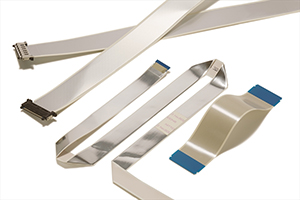
SUMI-CARD cables are cost-effective, lightweight cables that are used to transmit signals and power inside consumer electronics and in automotive applications. They are formed through a process of laminating multiple flat conductors with micrometer precision into a finished cable, which results in a significantly thinner, space-saving profile than conventional electronic cables. SUMI-CARD enables easy connections without miswiring. We can supply them in various lengths, conductor counts, and constructions. Among the available types: conventional, gold-plated, shielded (for enhanced EMI resistance), high-frequency, high-temperature and high-humidity resistant, and halogen-free. New types of SUMI-CARD are continually being developed for custom interconnects.
MFCX™ micro flex coaxial cables
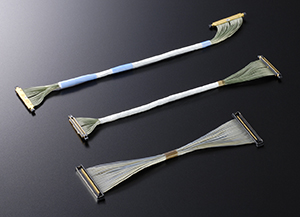
MFCX cables are extremely thin and highly flexible communication cables that are used for the internal wiring of electronic devices such as flat panel displays, laptops, smartphones, and medical equipment. They feature a very small outside diameter, typically between 0.20 to 0.35 mm (AWG 46 to 36). A bundle of 40 wires can be formed with a diameter of less than 3 mm. MFCX cables give electronics designers the ability to achieve high-speed data transmission while reducing either the size of an internal subsystem or the overall size of the device. Inside the cable, wires are individually shielded to provide excellent EMI resistance. A double-shielding option to further enhance noise immunity is also available. Cable assemblies are designed according to customer specifications, with further miniaturization being possible upon request.
Thunderbolt™ 5 cables
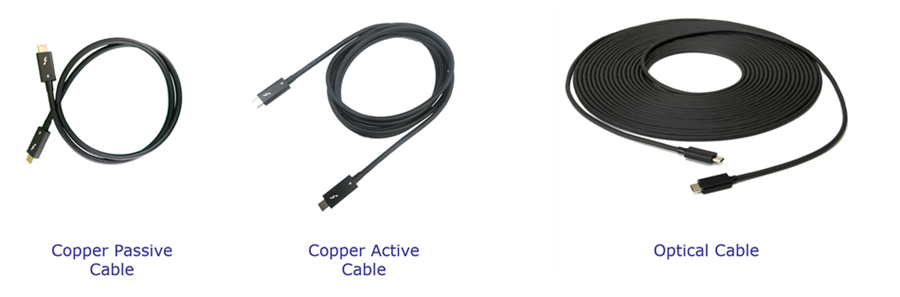
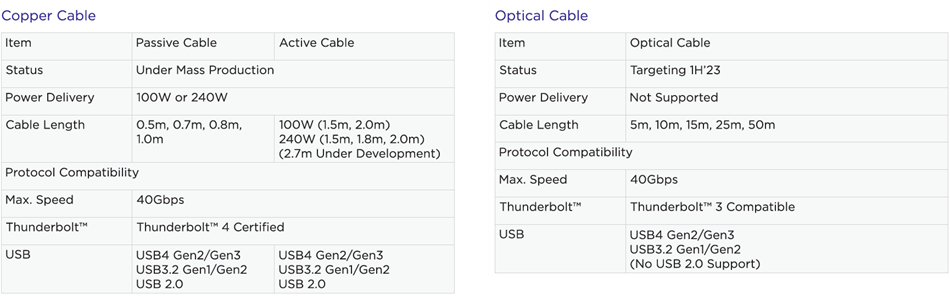
Thunderbolt™ 5 computer ports set a new benchmark in connectivity, offering the fastest, most reliable, and easiest way to power your devices and connect to your favorite accessories. Designed for ultimate performance and versatility, these cables redefine high-speed data transfer and video transmission.
Key features
- Supports up to three 4K 60Hz displays or multiple 8K displays with DisplayPort 2.1 compatibility
- Thin and lightweight design with enhanced bendability
- Constructed with low-smoke zero-halogen (LSZH) materials for safety
- Fully compliant with the USB4 specification
Advantages
- Soft yet durable construction, ideal for bending and moving parts
- Easy installation in narrow spaces requiring tight bending radius
- Delivers high-definition video and ultra-fast data transfer
- EMI/EMC compliant and environmentally friendly for reliable and sustainable performance
Applications
- Seamless connection between high-performance computers and human-interface devices
- Reliable link between high-definition real-time monitoring cameras and computers
- Enhanced experience connecting VR/MR headsets to computers for immersive environments
RGB laser modules

A display that uses a laser as a light source combines red (638 nm), green (520 nm), and blue (450 nm) laser beams, which are the three primary colors of light. This makes it possible to achieve full-color rendering.
Common methods for combining laser light include using collimating lenses and wavelength multiplexing filters for spatial coupling, or using optical waveguides, but these methods have problems with optical loss, cost-up, and miniaturization. We have developed spatial multiplexing technology that does not use lenses for R, G, and B laser beam multiplexing by applying high-precision mounting technology cultivated through the development of optical communication products. By reducing the number of optical components, we have achieved the world‘s smallest size (l5.0 x w5.2 x t3.3 mm) to the best of our knowledge.
Our original spatial multiplexing method minimizes loss due to optical multiplexing, so we have products ranging from low to high output. It can also be applied to the retinal imaging and waveguide lens method, which are considered promising in the future AR glasses and unique XR products.
The RGB multiplexed divergent beam light can be collimated by the customer using a single lens to obtain the optimum light source for Laser Beam Scanner (LBS) and illumination applications.
Product lineup

Technology

Easy assembly
