Case Studies

Home> Case Studies

These case studies highlight the advantages of POREFLON solutions,
including cost reduction, complying to strict regulations, and increasing the water flow rate.

Select the desired criteria to
narrow down the cases.

Application

Region

Improvement of wastewater treatment capacity at the soy product manufacturing plant Application:Food / Beverage Region:Japan

Improving treatment capacity to accommodate the increase in wastewater volume due to production expansion.
  • Objective
    Improving wastewater treatment capacity by utilizing existing facilities.
  • Background
    Due to increased production, there was a need to enhance wastewater treatment capacity, so we renovated the existing settling tank into a membrane bioreactor (MBR).
  • Results
    With the MBR conversion, which is characterized by space-saving features, we are able to treat a larger volume of wastewater in the same space, resulting in an improvement of wastewater treatment capacity from 160 m³/d to 400 m³/d. Additionally, the quality of the discharged wastewater has also improved.
  • Flow rate
    400㎥/d
Improvement of wastewater treatment capacity at the soy product manufacturing plant
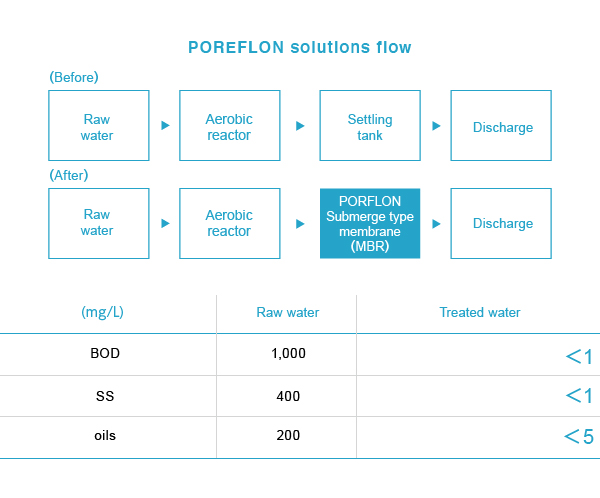
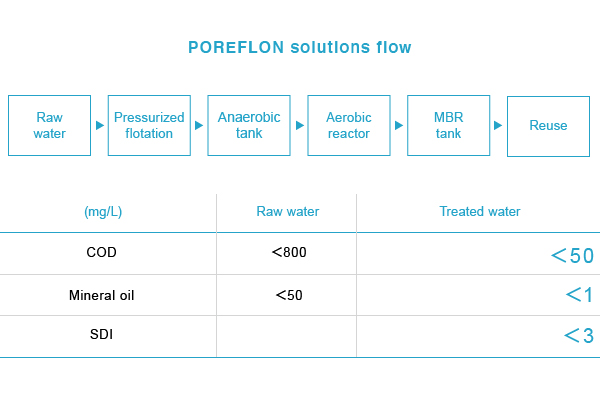
POREFLON solutions flow

Space-saving and water quality improvement at the food factory Application:Food / Beverage Region:Japan

Space-saving and water quality improvement through the introduction of MBR, with reduced operational costs due to remote monitoring.
  • Objective
    Improvement of discharge water quality and increased capacity for space-saving wastewater treatment.
  • Background
    In the food production factory in Japan, there was a need to expand existing water treatment facilities to accommodate increased production. The introduction of MBR aimed to achieve both space-saving and improved water quality.
  • Results
    With the introduction of MBR, we successfully enhanced wastewater treatment capacity while saving space. The introduction of membrane treatment improved the quality of the discharge water. Additionally, by implementing a remote monitoring system, we were able to reduce the time required for daily operational management.
  • Flow rate
    1400㎥/d

Adaption to strengthened wastewater quality regulations at the beverage factory Application:Food / Beverage Region:Japan

Improvement of wastewater quality through the introduction of MBR.
  • Objective
    Adaption to strengthened wastewater quality regulations.(Switching from sewage discharge to river discharge)
  • Background
    In the beverage factory in Japan, due to the strengthening of wastewater quality regulations, there was a need to renovate existing wastewater treatment facilities to improve water quality. To enhance wastewater quality while utilizing existing equipment and saving space, the introduction of MBR was considered.
  • Results
    With the introduction of MBR, we were able to implement membrane treatment in a space-saving manner while utilizing existing equipment. As a result, we were able to clear wastewater quality regulations.
  • Flow rate
    600㎥/d

Long-term stable operation of membranes at the food factory Application:Food / Beverage Region:Japan

Stable operation for over 13 years with long-life membranes.
  • Objective
    Enhancement of wastewater treatment capacity due to increased production volume.
  • Background
    In the food factory in Japan, there was a need to enhance wastewater treatment capacity due to increased production volume, leading to the introduction of POREFLON™ Submerge Type membranes in 2011.
  • Results
    Since the introduction of the membranes, we have achieved over 13 years of stable operation. Even when the flow rate decreased due to membrane clogging, we were able to recover the flow rate through chemical cleaning leveraging the chemical resistance of POREFLON™ Submerge Type membranes, thereby reducing the hassle and cost of membrane replacement.
  • Flow rate
    160㎥/d

Capacity enhancement with MBR systems that can be added in a short installation period at the food factory Application:Food / Beverage Region:Japan

MBR system that can be retrofitted with a short installation period.
  • Objective
    Enhancement of existing water treatment facilities with a short installation period and low cost.
  • Background
    In the food factory in Japan, the enhancement of wastewater treatment capacity due to increased wastewater volume has become urgent, leading to the introduction of an external MBR system that can be retrofitted to existing equipment with a short installation period.
  • Results
    We were able to improve wastewater treatment capacity by introducing an external MBR system without having to stop the existing water treatment facilities for an extended period. The external MBR, being a packaged system, can be installed at a lower cost compared to custom-made systems.
  • Flow rate
    200㎥/d

Wastewater reuse at the wire manufacturing plant Application:Metal processing Region:Japan

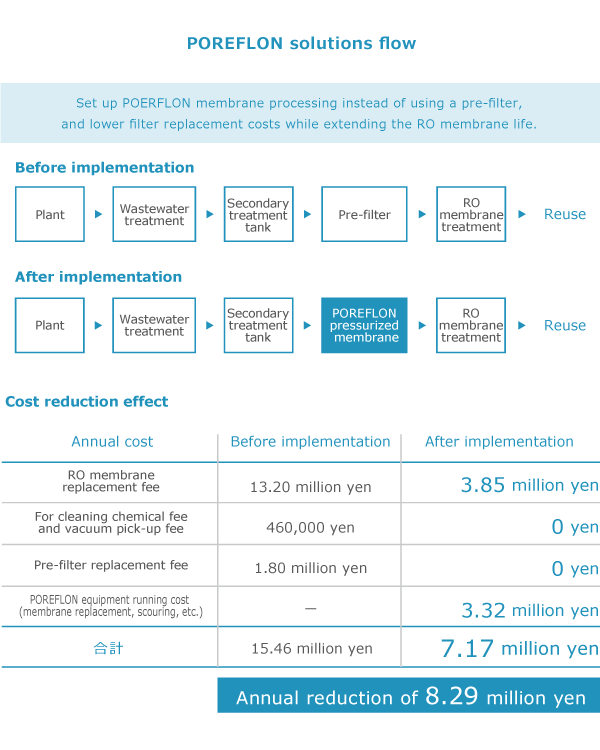
Cost savings of 57 thousand USD annually due to reduced RO load.
  • Objective
    Cost reduction.
  • Background
    To conserve water, we had equipped wastewater treatment facilities capable of reusing wastewater. However, there was an issue of load on the RO membrane, leading to costs associated with membrane cleaning and replacement. In pursuit of further cost reduction, we received an inquiry.
  • Results
    By replacing the prefilter used for RO pretreatment with Poreflon™
    External Pressure-type membranes, we were able to reduce the load on the RO membranes and significantly save on RO membrane cleaning and replacement costs. Even after considering the cost of the Poreflon pressurized membranes, we achieved an annual cost reduction of 57 thousand USD.
  • Flow rate
    240㎥/d
POREFLON solutions flow

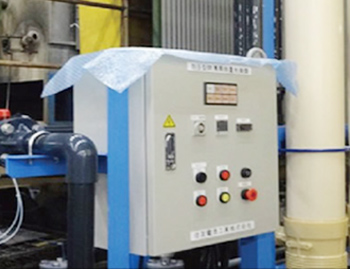
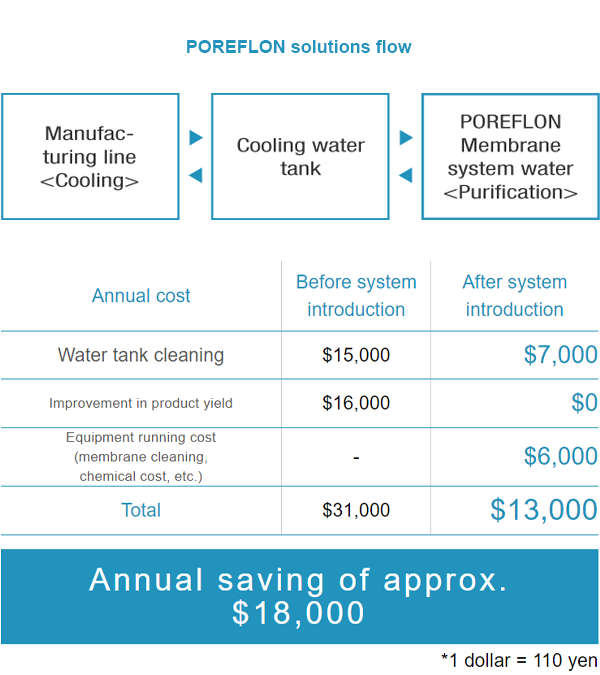
Cooling water purification at the electric wire manufacturing plant Application:Electric wire manufacturing Region:Japan

By improving yield through preventing dirt adhesion on the surface of wires, we achieved a cost reduction of 14 thousand USD annually.
  • Objective
    Prevention of surface contamination of wires caused by cooling water after rubber vulcanization treatment.
  • Background
    On the manufacturing line for wires, contamination from the cooling water was adhering to the surface of the wires, resulting in a deterioration in yield due to the need for rework. To improve the yield, we introduced membrane processing for the purification of the cooling water.
  • Results
    By purifying the cooling water with POREFLON™ membrane, we were able to prevent contamination on the surface of the wires due to the cooling water, achieve a reduction in cooling water tank cleaning costs, and improve yield, resulting in an annual cost reduction of approximately 14 thousand USD.
  • Flow rate
    260㎥/d
Cooling water purification at the electric wire manufacturing plant
POREFLON solutions flow

Wastewater Reuse at the electronic Components Manufacturing Plant Application:Electronic component manufacturing Region:Japan

Annual cost reduction of 310 thousand USD through the reuse of factory wastewater.
  • Objective
    Increasing the reuse of factory wastewater to save on water and sewage fees.
  • Background
    The factory had a high water usage, resulting in significant water and sewage fees, which created a need for wastewater reuse aimed at cost reduction and environmental conservation.
  • Results
    The introduction of Poreflon membrane treatment led to an increase in wastewater reuse and a reduction in water and sewage usage, resulting in annual cost savings of 310 thousand USD.
  • Flow rate
    1,200㎥/d
Annual cost reduction of 310 thousand USD through the reuse of factory wastewater.
POREFLON solutions flow

Reduction of industrial waste at the automobile manufacturing company Application:Machining Region:Japan

Reduction of environmental impact by achieving a 90% reduction in coolant wastewater.
  • Objective
    Reduction of industrial waste and reuse of coolant.
  • Background
    In the automobile manufacturing plant, coolant wastewater containing oil was treated as industrial waste. There was a need to reduce industrial waste with the aim of lowering environmental impact.
  • Results
    By treating coolant wastewater with Poreflon™ External Pressure-type membranes, we succeeded in concentrating the wastewater and reducing industrial waste by 90%. The filtered water is being reused as coolant.
  • Flow rate
    2㎥/d
Reduction of environmental impact by achieving a 90% reduction in coolant wastewater.
POREFLON solutions flow

Improvement of wastewater treatment capacity at the textile dyeing factory Application:Dyeing fiber Region:Japan

Stable treatment of non-degradable substances and reduction of COD.
  • Objective
    Addressing the aging of existing facilities and improving treatment capacity.
  • Background
    The synthetic resin PVA, used as a binder for textiles, is not easily biodegradable in activated sludge and tends to foul membranes, leading to challenges in wastewater treatment for textile dyeing factories.
  • Results
    By introducing a membrane bioreactor (MBR) using Poreflon® membranes with high fouling resistance, we increased the concentration of activated sludge compared to conventional biological treatment and extended the SRT (sludge retention time), thereby stabilizing the retention of PVA-degrading bacteria. As a result, we successfully achieved stable treatment of non-degradable substances and reduction of COD.
  • Flow rate
    1,600㎥/d
Improvement of wastewater treatment capacity at the textile dyeing factory
POREFLON solutions flow

Improvement of wastewater treatment capacity at the textile dyeing factory Application:Dyeing fiber Region:Southeast Asia

Stable treatment of non-degradable substances and reduction of COD.
  • Objective
    Development of wastewater treatment facilities associated with the construction of a new factory.
  • Background
    Introduction of wastewater treatment facilities similar to those in existing factories in Japan to the new factory in Thailand.
  • Results
    In addition to achieving stable treatment of non-degradable substances and reduction of COD, we were able to realize significant improvements in the reduction of industrial waste, energy costs, and installation area.
  • Flow rate
    800㎥/d
Improvement of wastewater treatment capacity at the textile dyeing factory
POREFLON solutions flow

Wastewater reuse at the petrochemical plant Application:Petrochemical manufacturing Region:Southeast Asia

Promotion of the reuse of wastewater containing oil.
  • Objective
    Adaptation to the strengthening of wastewater regulations.
  • Background
    In Singapore, which has limited land and low water retention relative to its rainfall, the promotion of water storage and reuse is being implemented as a response to water resource scarcity. In the petrochemical industry, while wastewater from the factory was being reused, there was an increasing demand for improved treated water quality due to stricter regulations.
  • Results
    By introducing high oil-resistant POREFLON™ MF membranes after biological treatment and before RO membrane treatment, we were able to remove oil and suspended solids from the wastewater, thereby improving the quality of the treated wastewater.
  • Flow rate
    2,400㎥/d
Wastewater reuse at the petrochemical plant

Wastewater reuse at the oil refinery Application:Refinery Region:Taiwan

Achievement of an 85% wastewater recovery rate.
  • Objective
    Adaption to regulations mandating wastewater reuse.
  • Background
    In Taiwan, a small island nation with many mountainous areas and high demand for industrial water, wastewater reuse has become a critical issue due to serious water shortages. Major oil refining companies in Taiwan have also begun considering the introduction of membrane bioreactors (MBR) in response to regulations mandating the reuse of industrial wastewater.
  • Results
    We addressed the issue of membrane clogging caused by mineral oil through the optimization of membrane pore size and the use of chemical-resistant Poreflon membranes for membrane cleaning, achieving a wastewater recovery rate of over 85% with the introduction of MBR.
  • Flow rate
    6,000㎥/d
Wastewater reuse at the oil refinery
POREFLON solutions flow

Improvement of discharge water quality at the oil refinery Application:refinery Region:Southeast Asia

Improvement of discharge water quality through the introduction of MBR.
  • Objective
    Improvement of discharge water quality of oily wastewater.
  • Background
    At a palm oil manufacturing plant in Malaysia, an MBR using POREFLON™ membranes has been introduced to treat oily wastewater and improve the quality of the discharge water.
  • Results
    The implementation of MBR has improved the discharge water quality. While the flow rate may decline with continuous operation, we have been able to enhance the flow rate again through Off-Line Cleaning utilizing the chemical resistance of POREFLON™ membranes, allowing for continued use.
  • Flow rate
    530㎥/d
Improvement of discharge water quality at the oil refinery

Wastewater treatment in the large commercial facilities with space-saving solutions Application:Commercial facility Region:Southeast Asia

Wastewater treatment with space-saving solutions through the introduction of MBR.
  • Objective
    Wastewater treatment in limited underground space.
  • Background
    With the construction of a large commercial facility in Thailand, wastewater treatment in limited underground space has become necessary.
  • Results
    The introduction of MBR, which eliminates the need for a settling tank, has achieved space-saving, allowing us to perform wastewater treatment in underground facilities.
  • Flow rate
    2,000㎥/d
Wastewater treatment with space-saving solutions through the introduction of MBR.

Achievement of wastewater quality regulations at the sewage treatment plant Application:Water and sewage Region:China

Improvement of discharge water quality at large-scale sewage treatment plants.
  • Objective
    Adaption to strengthened wastewater quality regulations.
  • Background
    In China, where environmental pollution from the discharge of domestic wastewater into rivers has become a concern, the national government strengthened wastewater quality regulations starting in 2015.
  • Results
    Compared to conventional activated sludge processes, the implementation of MBR, which yields clearer treated water, has led to improved wastewater quality and allowed us to meet regulatory standards.
  • Flow rate
    200,000㎥/d
Achievement of wastewater quality regulations at the sewage treatment plant

Wastewater reuse at the sewage treatment plant Application:Water and sewage Region:China

Wastewater reuse through External Pressure-type membranes (UF membranes) treatment.
  • Objective
    Reuse of domestic wastewater.
  • Background
    At sewage treatment plants in China, there was a need for the reuse of domestic wastewater aimed at environmental conservation.
  • Results
    By combining biological treatment with POREFLON™ External Pressure-type membranes treatment, we achieved a reduction in suspended solids in the treated water and a decrease in turbidity, enabling reuse as water supply.
  • Flow rate
    15,000㎥/d
Wastewater reuse at the sewage treatment plant

Seawater desalination Application:Water and sewage Region:South Korea

Seawater desalination through through External Pressure-type membrane (UF) treatment as a pre-treatment for RO membranes.
  • Objective
    Utilization of seawater through seawater desalination.
  • Background
    In South Korea, research on seawater desalination technology is progressing as a measure against drought. The introduction of External Pressure-type membranes (UF membranes) has been considered as a pre-treatment for RO membrane processing required for desalination.
  • Results
    The introduction of POREFLON™ External Pressure-type  membrane treatment as a pre-treatment for RO membranes contributes to seawater desalination.
  • Flow rate
    500㎥/d
Seawater desalination

No Case Studies.